
Stop Chasing Unicorn Grants: Lived Lessons on Scaling from IFIN’s Portugal Retreat
What innovation leaders from WWF, CARE, Save the Children, DanChurchAid, The Nature Conservancy, and beyond wish they’d known sooner about getting from pilot to real-world scale.
The mood in the room
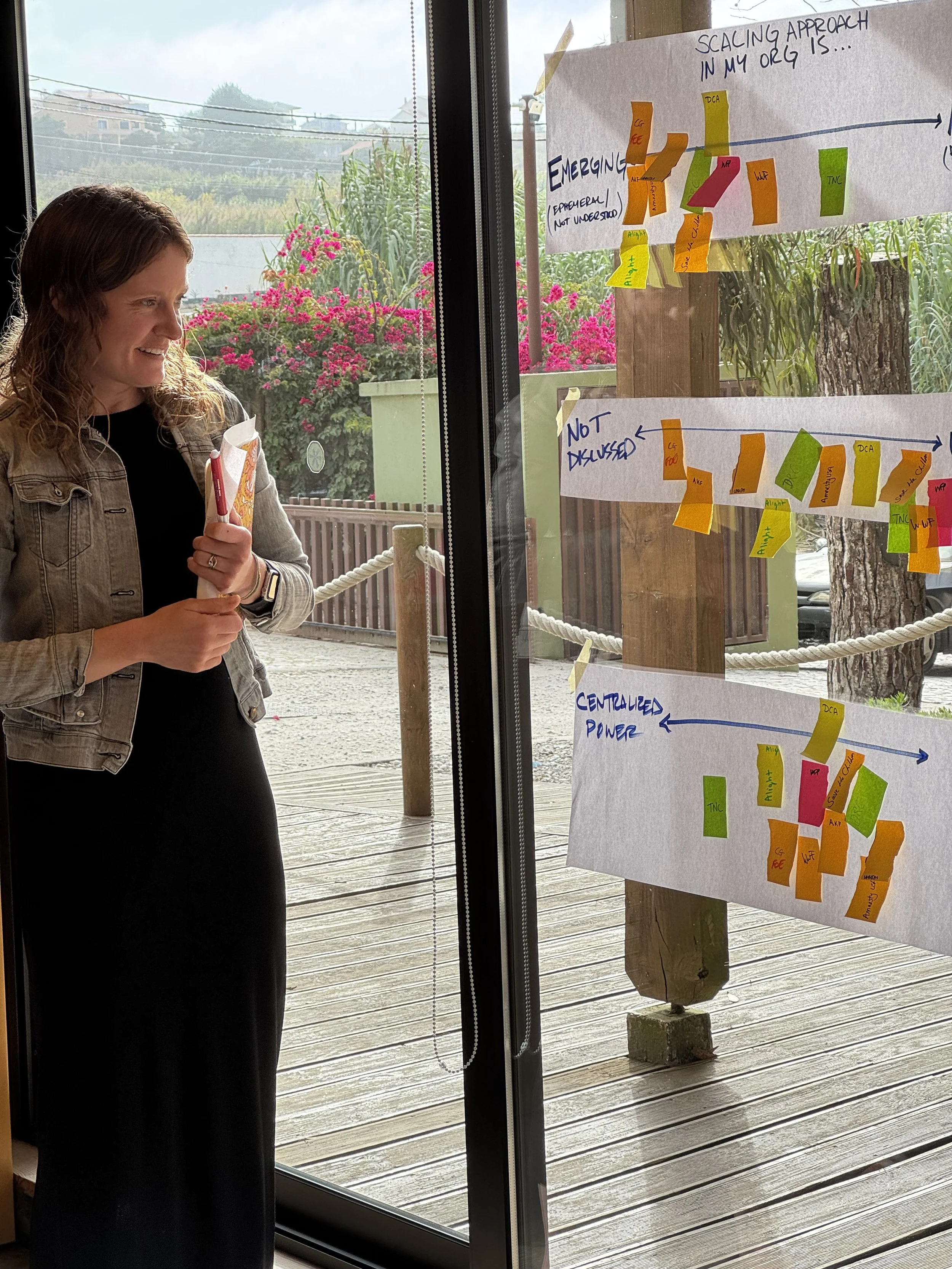
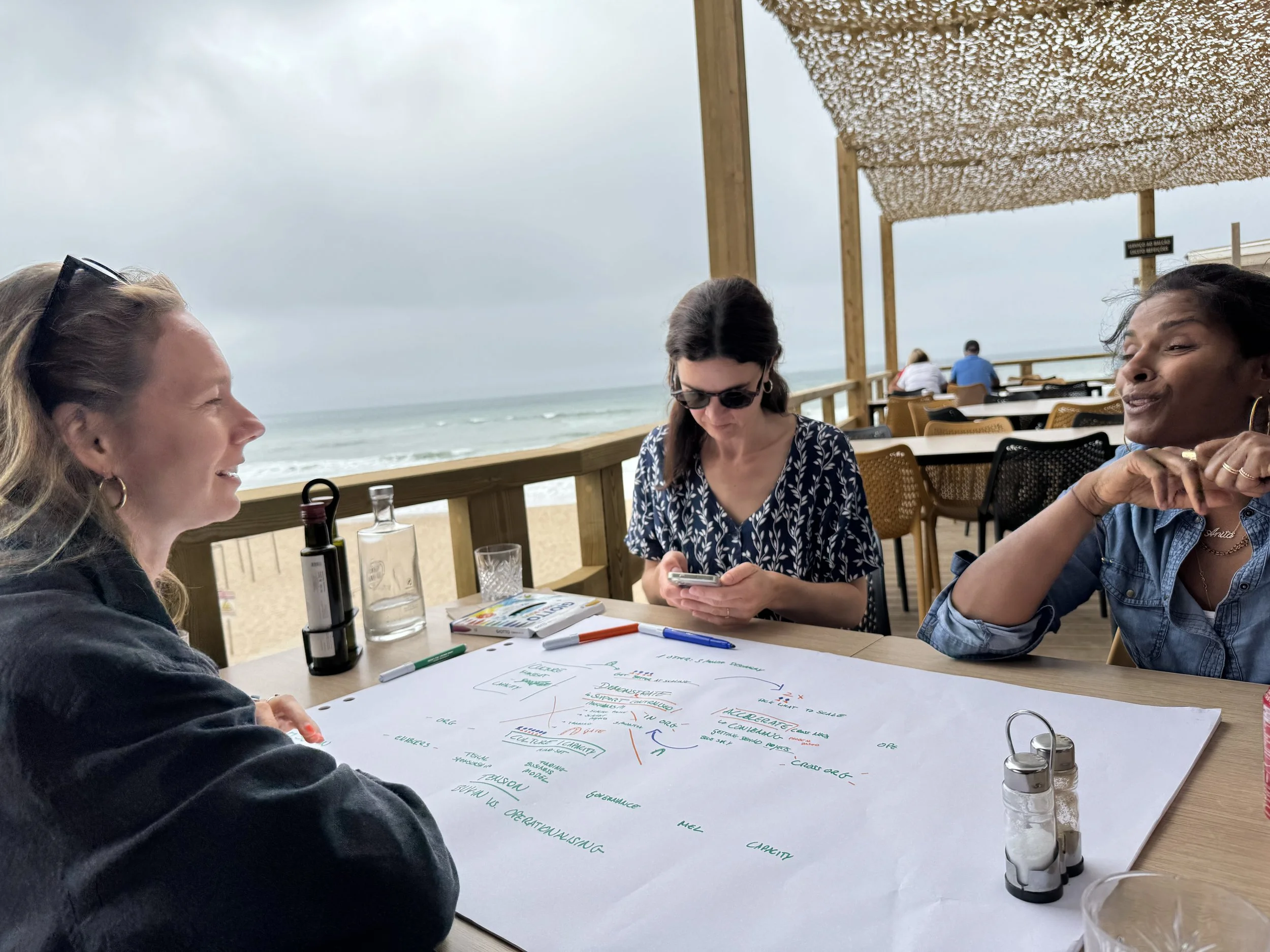
Across a morning of candid exchange we compared scars and wins from trying to scale promising pilots into durable, country-level or multi-country programs. We distilled lived experiences into the below patterns and traps to avoid to improve your odds of scaling impact.
Six truths we kept circling back to
1) A single “big grant” rarely scales anything
The most persistent myth: land one huge grant and scale will magically follow. Practitioners reported the opposite–patchwork, braided funding including from non-grant local resources was a stronger predictor of scale because it forces adaptability, co-ownership, and resilience. Translation: build a mosaic, not a monolith.
Try this: Map 3–5 funding lanes or “payers at scale” (bilateral, private philanthropy, cost-sharing with implementers, fee-for-service with governments, in-kind with private sector). Design your next phase to work even if any one lane drops out.
2) Most things that “work” won’t scale and that’s okay
Many pilots are too complex, grant-dependent, or “hero-team” specific to sustain beyond the pilot. Not everything that succeeds should scale; some interventions remain legitimate public goods that philanthropic or public funding should underwrite.
Try this: Run a “Scalability Screen” before investing in replication: evidence threshold, simplicity of the core, cost curve at volume, and the presence of external payers/doers ready to adopt. If a solution fails the screen, re-classify it as a public good, or isolate its most scalable component that is a core impact driver and double down there.
3) Design for scale from day one (or pay interest forever)
Retrofitting a grant-shaped program into a scale-ready model later is painful. Teams that embed a scale theory of change into program design, including pathways to government or private-sector adoption, cut rework dramatically.
Try this: Inception checklist: Who is the doer at scale? Who is the payer at scale? What unit economics would they need to see? Which parts of the model must be locally led to endure? Document these pre-pilot.
4) Commercial thinking belongs early - keep a “living business case”
Project teams too often finish a pilot then ask if the economics work. Build an “agile economics” habit: sketch the cost-to-impact logic early and update it at each milestone. Remember, cost/outcome should improve as you scale!
Try this: Maintain a one-page “living business model for impact” that tracks cost per outcome across geographies and scenarios; insist the ratio improves as you scale, or you’re just replicating.
5) Get your scale partner in the room early
Whoever will adopt, finance, and operate your model at scale–government divisions, private operators, civil society networks–must co-shape the model early or buy-in will be fragile later.
Try this: Treat the ministry, insurer, or network federation as a co-designer from month one. Build the “handover pathway” into your workplan, not as an afterthought.
6) Mindsets and narrative move systems
The best scaling leaders are coalition builders and know how to tell a story. Invest in champions and craft compelling narratives and educational tools / training tied to a moment (policy window, budget cycle, crisis, or technology shift).
Try this: Name one mindset shift needed to unlock scale (e.g., from “projects” to “platforms”). Craft a simple, repeatable story or visual that reframes the issue for others, then tie it to a timely moment to spark action.
Field notes: What different organizations are doing for scale
WWF: Shifting Scaling Mindsets and Understanding
Provides leadership and conservation team training on key scaling concepts, as well as provides targeted support for teams asking key questions: 1)What should we scale? 2) How do we design scalable projects? And 3) What do we need to support scale efforts successfully?
Save the Children: Building a pipeline from harvest to acceleration
“Clear for Launch” moves post-prototype solutions through a transparent process into a ‘what works’ lab (criteria: scalable, evidence-informed, locally-led, innovative) and aims to accelerate three innovations per year with funding, support, open dissemination, and integration.
DanChurchAid (DCA): Centering localization for durable scale
Localization, from problem definition to solution governance, is a non-negotiable at DCA for relevance and durability. Through DCA’s Innovation Fund focus is on designing the innovation process and scaling routes so local actors and communities have real decision rights, budget visibility, and implementation ownership and influence. Only locally relevant solutions will ultimately scale and contribute to more with less.
CARE: A sharper, scale-by-design approach
CARE emphasizes competitive analysis (what is our unique value in an ecosystem of solvers?) and partners with evidence groups such as IDinsight to stress-test whether models can actually scale. For complex problems, they break out scalable components rather than force end-to-end replication.
The Nature Conservancy (TNC): Entrepreneurial scaling support
TNC embedded entrepreneurial operators inside teams to test delivery at scale. Working heuristics: Big Enough (problem breadth), Simple Enough (replicable core), Good Enough (evidence of measurable impact), Cheap Enough (fits payer/doer budgets). The main barrier wasn’t “strategy on paper,” it was building the scalable delivery model and systems to execute.
World Food Programme (WFP): Scale = localisation + sustainability
At WFP’s IGNITE Hub, scaling isn’t just about doing more - it’s about doing better, with local leadership and smart financing at the heart. Scaling means turning promising ideas into lasting solutions by working closely with local partners who know their communities best. Instead of relying only on grants, WFP uses blended finance: combining donor funds with private capital to help local businesses grow, become investment-ready, and lead the way. This approach not only strengthens local economies but also ensures that solutions are sustainable, cost-effective, and truly owned by the people they serve.
What If Innovation (Accenture): Borrowed habits from the private sector
Fall in love with the problem, not the first solution; improve unit economics with growth; be ruthless about prioritization; and use constructive outsiders to tune the model before chasing scale.
Thanks & acknowledgements
Gratitude to colleagues who shared their scaling experiences and tools: Save the Children (Maggie Korde), DanChurchAid (Christina Dahl Jensen), CARE (Anita Akella), The Nature Conservancy (Jess Lybeck), World Food Programme (Emma-Lee Knape), WWF (Anne Merkle) and What If Innovation – Accenture (Jamie Wright). This synthesis reflects group discussion at the IFIN retreat in Lisbon, September 2025.
Want more like this?
IFIN’s Knowledge Hub curates member articles, resources, and tools on mainstreaming innovation culture and scaling impact. To contribute a “Scale Snapshot” or a short case note on economics or delivery models, contact the IFIN team.