
Building Scalable Solutions
Once you’ve identified your pathway, the next step is to ensure your solution is actually built for scale. Some brilliant pilots stall when scaling because they weren’t designed with the right future actors, conditions, or constraints in mind.
Doers and Payers at Scale
You can’t scale a solution alone. Achieving scale means identifying the right doers - the people or institutions that can deliver your solution - and the payers- those who will sustainably fund its delivery.
This is where collaboration becomes essential. As Kevin Starr puts it in The Doer and the Payer, scaling impact requires enabling others to take your solution forward. These actors must be identified and engaged early, as part of your design and testing process.

Develop, design and initially test new interventions, products, programs, or services

Produce, deliver and supply the innovation (product or service)
Common doers at scale include:
Your own team or organisation
Businesses that can deliver the solution for profit
NGOs that integrate it into their work
Governments that embed it into public systems

Finance going to scale and/or implementation at scale. They can include Users, Government or external donors.
Likely payers include:
Customers (if delivered as a product or service)
Philanthropic donors
Governments
Multilateral or bilateral aid institutions
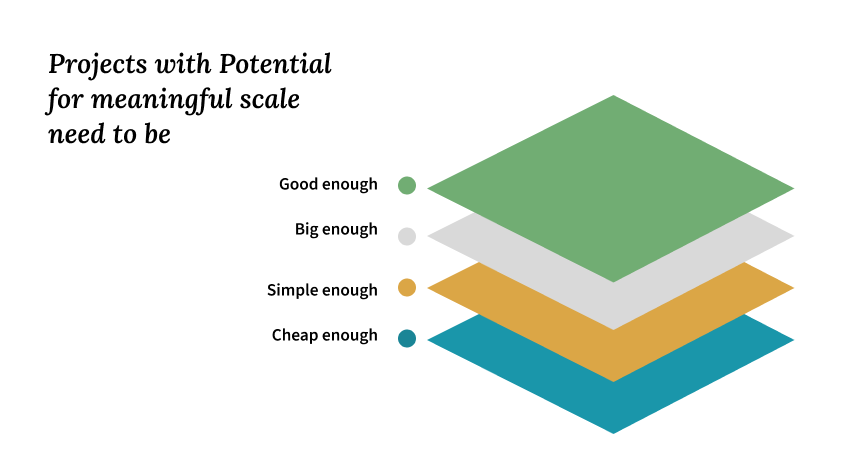
The Four Enoughs
Not every impactful solution is scalable. These four criteria help assess whether your solution is truly ready to be taken on by others and grow beyond your team.
Big enough
Is your solution aiming to make a real dent in the problem?
Scalable solutions don’t nibble at the edges, they’re designed to address a substantial portion of a clearly defined issue. That means understanding where the problem is most acute, and whether your solution can be effectively implemented there.
Think of this as identifying your addressable market - the intersection between high need and high feasibility.
Ask yourself:
Does the potential impact of the solution match the scale of the problem?
Are there enough places or contexts where this need exists and where our model can actually work?
Simple Enough
Can someone else implement it - without us?
Scalable models are those that others can adopt and run with. If a solution requires rare expertise, constant hand-holding, or niche conditions to work, it’s unlikely to scale.
Simplicity here means designing for clarity and usability, not oversimplifying impact, but being clear on what’s essential, and removing the rest.
Ask yourself:
Can someone outside our team implement the solution accurately?
Have we identified and documented the non-negotiables?
Have we removed unnecessary complexity?
Good Enough
Has your solution been proven under real-world conditions and is it replicable?
A scalable solution isn’t just impactful once. It needs to show consistent, reliable results across different settings. That includes testing under the kinds of conditions you’d face at scale, not ideal pilot environments with extra support.
It should also have the operational and monitoring systems in place to support replication and be adaptable to diverse contexts.
Ask yourself:
Have we tested this model in different places, under realistic delivery conditions?
Are systems in place to support consistent quality at scale?
Can the model flex without compromising core impact?
Cheap Enough
Is it financially viable for those who need to deliver it?
Scaling depends on whether someone can and will pay for delivery over the long term. The solution needs a credible cost structure that fits within what governments, donors, or customers are willing and able to fund.
This isn’t about being the cheapest option, but being affordable enough for real-world adoption and sustained delivery.
Ask yourself:
Have we identified the likely payers, and do we understand what they fund?
Is the cost per unit of impact viable compared to alternatives?
Is the cost structure sustainable at scale—not just in pilot phases?